.1).png.2608181633052.webp)
You rarely forget the first time you see winged insects pouring toward a window inside your home. In Southern California, that moment often leads to a single, urgent question: are these flying ants or termite swarmers, and how worried should we be?
We have spent more than 30 years helping Southern California homeowners figure out that exact problem, sometimes from a single photo sent to us within minutes of a swarm. If you are staring at wings on the floor or insects on the glass right now, a few quick visual checks can usually tell you which one you are dealing with.
The Three Physical Clues That Settle It Fast
When you are comparing flying ants vs termite swarmers, three body features give you a reliable answer in seconds: waist shape, wings, and antennae. You do not need a microscope, just a calm look and maybe your phone’s camera zoom.
Waist Shape: Straight Tube vs. Pinched Middle
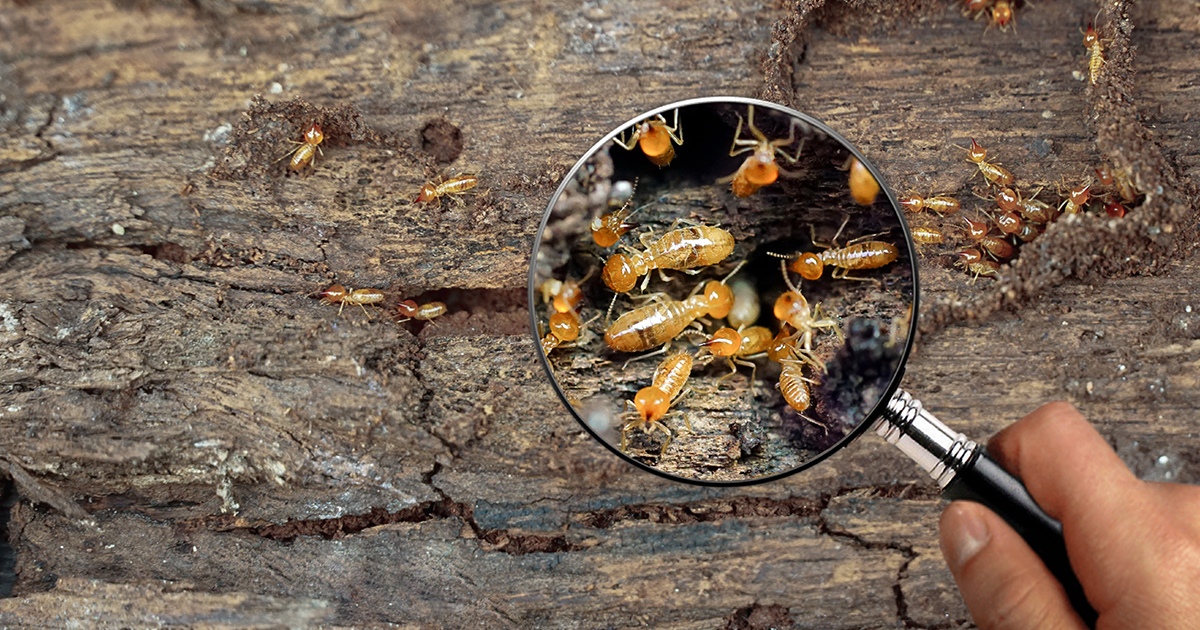
Termite swarmers, also called alates, have a straight, tube-like body. There is no obvious pinch in the middle, so the head, middle, and back end blend into one smooth shape. If the body looks like a grain of rice with wings, you are probably looking at termites.
Flying ants have a very different profile. Their waist is clearly pinched, creating three easy-to-see segments: head, middle, and back. If it looks more like a tiny wasp with a “squeezed” middle, that is a flying ant.
Wings: All the Same Length vs. Two Big, Two Small
Termite swarmers have four wings that are all the same length. They extend well past the back of the body and look almost like a single long pair stacked together. In good light they appear white or translucent.
Flying ants also have four wings, but the front pair is clearly larger than the back pair. From above, you will notice the front wings reaching farther back than the rear wings, and the overall wing color leans more brown or yellow-tinted.
Antennae: Straight Beads vs. Elbowed
Termite antennae are straight and bead-like, with a gentle curve at most. If you zoom in with your phone and see what looks like a short string of beads pointing forward, that fits termites.
Flying ant antennae are elbowed, with a sharp bend that almost looks like a tiny right angle. If you can see a clear “kink” or bend partway along the antenna, you are likely dealing with ants.
One Clue You Can Spot Without Catching the Insect
Sometimes the swarm is over by the time you notice. The insects are gone, but the wings they leave behind can still tell the story.
Termite swarmers shed their wings very quickly after landing. Indoors, this leaves piles or tight clusters of white, translucent wings along windowsills, sliding glass door tracks, door frames, and light fixtures. The wings tend to be equal in length and often stack together in little drifts that almost look like fish scales.
Flying ants shed wings too, but not in the same way. Their wings usually scatter more randomly and are often yellow-tinted or brownish instead of glassy white. You are more likely to see a few separate wings here and there instead of dense stacks or piles.
From across the room, this gives you a quick distance clue. Termite wings stack and blur together into pale, white masses near light sources and windows. Flying ant wings stay more separate, and you can often see individual pointed tips rather than one solid patch.
What Southern California Homeowners Need to Know About Swarm Timing
Most national articles talk about a single “termite season.” That does not match reality here. In Southern California, our mild winters mean termite activity can continue year-round, and different species swarm at different times of year and even different times of day.
Drywood Termites: Daytime Swarmers from Late Summer into Fall
Drywood termites, especially Incisitermes minor, are the dominant termite species in Southern California. They live entirely inside dry wood, so they do not need soil contact or mud tubes to survive.
Drywood termite swarmers appear during daytime hours from late summer into early fall, with activity peaking roughly September through November in Orange County and Los Angeles County. If you see a daytime swarm near eaves, attic vents, fascia boards, or wood siding during that window, termites are much more likely than flying ants in our region.
Western Subterranean Termites: Spring Swarms after Warm Rain
Western subterranean termites, Reticulitermes hesperus, are the most destructive subterranean species in coastal Southern California. Unlike drywood termites, they nest in the soil and travel into structures through hidden mud tubes.
These termites typically swarm in spring, from March through May, especially on warm days following rainfall. You might see swarmers near the foundation, ground-level door frames, garage thresholds, or lower portions of walls and sliding glass doors. If the timing matches and you are near the ground, subterranean termites move up the list of suspects.
Formosan Subterranean Termites: Evening Swarms in the San Diego Area
Formosan subterranean termites have been confirmed in parts of San Diego County, and they have a different pattern again. Their swarmers usually take flight in the evening from late May through early August.
This species is considered one of the most destructive termites in the world. If you are in or near San Diego and notice an evening swarm around lights in that late spring to mid-summer window, it is worth getting a fast, professional identification, even if you are not sure whether you are seeing flying ants vs termite swarmers.
Indoor Swarm vs. Outdoor Swarm: Why Location Changes the Urgency
Where the swarm happens tells you almost as much as what the insect looks like. Indoor and outdoor swarms carry very different levels of urgency.
Indoor Swarmers Signal a Colony Already in the Structure
Swarmers appearing indoors, especially around interior windows, light fixtures, or in the middle of a room, usually mean there is a mature colony already in or directly under your home. Termite colonies have to be established for at least a year before they produce alates, the winged reproductives that swarm.
In practice, that means damage may already be underway in hidden structural wood, attic framing, subflooring, or wall studs by the time you see even a small indoor swarm.
Outdoor Swarms May Be Coming from Nearby Sources
Outdoor swarms around porch lights, garden lights, or trees can still be serious, but they are not always coming from your structure. The swarm could be emerging from a dead tree, stump, fence post, or a neighboring property.
Those swarmers are actively searching for new places to start colonies, which can include eaves, rooflines, and cracks around windows. So while outdoor swarmers are not always proof of an existing infestation inside your home, they are a warning to check vulnerable areas and consider a termite inspection.
Why Indoor Sightings Need Faster Action
Indoor swarmers indicate that termites may already be feeding on wood inside your walls or attic, not just exploring from the outside. That is why we treat indoor sightings as a higher priority and recommend a prompt inspection even if you are still debating whether you saw flying ants or termite swarmers.
Flying Ants Are a Nuisance. Termites Are a Structural Risk.
Flying ants can be annoying, but they are not in the same category of risk as termites for your home’s structure.
Most flying ants feed on food sources like other insects, sweets, or proteins. They do not eat wood, and in Southern California, true carpenter ants that can excavate wood are much less common than in places like the Pacific Northwest.
Because carpenter ants are relatively rare here, a daytime swarm around dry structural wood, eaves, or attic vents is statistically more likely to involve termites than carpenter ants.
Termites, on the other hand, live on cellulose, the main component of wood and many building materials. A termite colony consumes cellulose from structural beams, subfloors, trim, and furniture quietly and continuously. By the time a colony produces swarmers, it has often been active for years.
Another important difference is financial. Standard homeowners insurance policies do not cover termite damage, because insurers consider it a preventable maintenance issue. Catching and treating a colony early, when you first see swarmers or clues like frass (the tiny, sand-like termite fecal pellets from drywood termites) or mud tubes from subterranean termites, almost always costs less than waiting until damage becomes obvious.
What to Do the Moment You Spot Swarmers
When winged insects suddenly appear, it is tempting to grab a can of spray and start blasting. That instinct is understandable, but there is a better way to protect your home and get clear answers.
Skip the Store-Bought Spray
We do not recommend spraying swarmers with consumer pesticides. Surface sprays usually kill only the insects you can see and can scatter the swarm, making it harder to track where they came from. They do not reach the hidden colony inside wood or soil.
In some cases, heavy spraying can even wipe away useful evidence that helps a professional inspector quickly pinpoint activity.
Capture Photos or a Few Specimens
If you can do it safely, take clear photos of the insects and the wings left behind. Try to get at least one close-up of the body and antennae, and one shot of any wing piles along windows or doors.
We offer a convenient send-a-photo tool that lets you share those images with our team for fast feedback. It is a simple way to get an initial read on whether you are dealing with flying ants vs termite swarmers without having to guess.
Schedule a Professional Termite Inspection
Whether you are 90 percent sure you saw termites or still on the fence, a free termite inspection is usually the smartest next step. A trained inspector will look for:
- Drywood termite signs inside wood, including frass and small kick-out holes
- Western subterranean termite indicators such as mud tubes on foundations or in crawl spaces
- Moisture conditions and wood-to-soil contacts that increase risk
- Any other pest activity, including ants, rodents, or general household pests
At Kilter Termite & Pest Control, we focus heavily on effective treatments that do not require you to leave your home. Our KILGUARD™ and KILFOAM™ termite treatment systems are designed to eliminate both drywood and subterranean termites without tenting, toxic fumes, or moving out. Every termite service we perform comes with a two-year “No Problem” whole-home warranty, so if termites come back anywhere in your home during that period, we return at no charge.
If you are in Southern California and have just spotted swarmers or piles of wings, it is worth treating that as a time-sensitive signal rather than something to watch and wait on. A quick inspection now can prevent much larger repairs later. When you are ready for answers, we are here at Kilter Termite and Pest Control to take a look, walk you through what we find, and explain your options in plain language. You can reach us anytime at (866) 827-1727.